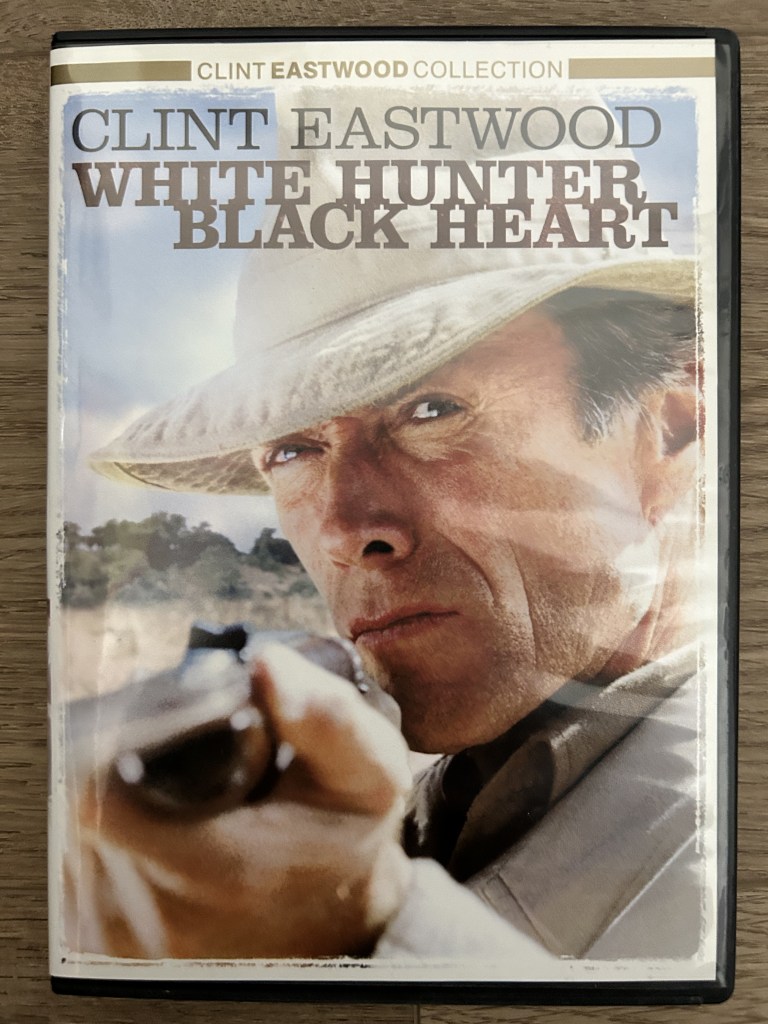
White Hunter, Black Heart 1990, directed by Clint Eastwood
Rating: 9/10
I love The African Queen directed by John Huston and starring Humphrey Bogart and Katharine Hepburn. I also read (and highly recommend!) The Making of The African Queen or How I Went to Africa with Bogart, Bacall and Huston and Almost Lost My Mind by Katharine Hepburn. So when listening to the fantastic podcast You Must Remember This and heard that Clint Eastwood made a movie basically about the filming of The African Queen where he plays a character that is basically John Huston, I was super excited and when I eventually watched the movie it did not let me down.
The book White Hunter, Black Heart (which I have not read, but probably would really enjoy) was written by Peter Viertel who was an uncredited (re)writer on The African Queen’s script and who wrote the novel based on his experiences doing that job while in Africa with the cast and crew. I always find these looks at historic moments but lightly fictionalized for dramatic purposes based off the recollections of an insider who was also kind of an outsider to be very interesting (see also Primary Colors which is kinda-sorta the Clinton presidential campaign). Jeff Fahey does a great job in the lead playing Viertel’s stand-in Pete Verrill. I grew up loving Jeff Fahey on Lost, so every time I see him in a movie (from 1986’s Psycho III all the way through to last year’s Horizon: An American Saga—Chapter 1) I get excited. The meatiest role of course goes to Clint Eastwood as John Wilson. Eastwood’s reputation as a director is very different than the one John Huston garnered for himself, but their filmic sensibilities are very aligned so to see Eastwood embody someone who is likely one of his heroes is a great feeling (similar to how great it was to see the dear departed David Lynch as John Ford in The Fabelmans). The casting I was most speculative of before watching this movie was Marisa Berenson as Kay Gibson (a facsimile of Katharine Hepburn). Berenson is a fantastic model-turned-actor who is memorable in films like Cabaret, Barry Lyndon, and I Am Love, but despite the variety of her roles in those films she didn’t feel very Hepburn-ish to me. I was very wrong and her portrayal of Gibson is one of the high points in this film.
Eastwood of course puts his own stamp on this material, so that even while making this movie about another great filmmaker making a great film, he still questions the typical view of masculinity. This theme in Eastwood’s oeuvre is probably most obvious in Cry Macho, but it is clear here as well with Eastwood as director and actor paying tribute to John Huston but also letting the audience see how ridiculous his over-the-top manly behavior can be, especially with his obsession over hunting. As his obsession brings more and more harm to those around him, it becomes clear that Wilson is not someone that we should see completely as a role model, even though he is undeniably cool and the film is not completely forsaking him. He may let his machismo get out of control, but eventually he is man enough to know when to call it quits (though admittedly too late) and admit that others may have been right. Overall, I love the meta-ness of Eastwood, a director who is often seen as super in control of his material making a movie about a director who is very much not, even though the final products never really betray that.
I find it endlessly fascinating how Clint Eastwood as an actor has become so tied to this vision of masculinity that his directing career has spent so much time trying to disengage from, and White Hunter, Black Heart is maybe my favorite example of him wrestling with this unevenness. It may not be as much of a masterpiece as Eastwood’s best films, but it is definitely one of the ones I enjoy watching and ruminating on the most.
 The Movie Room
Leave a comment