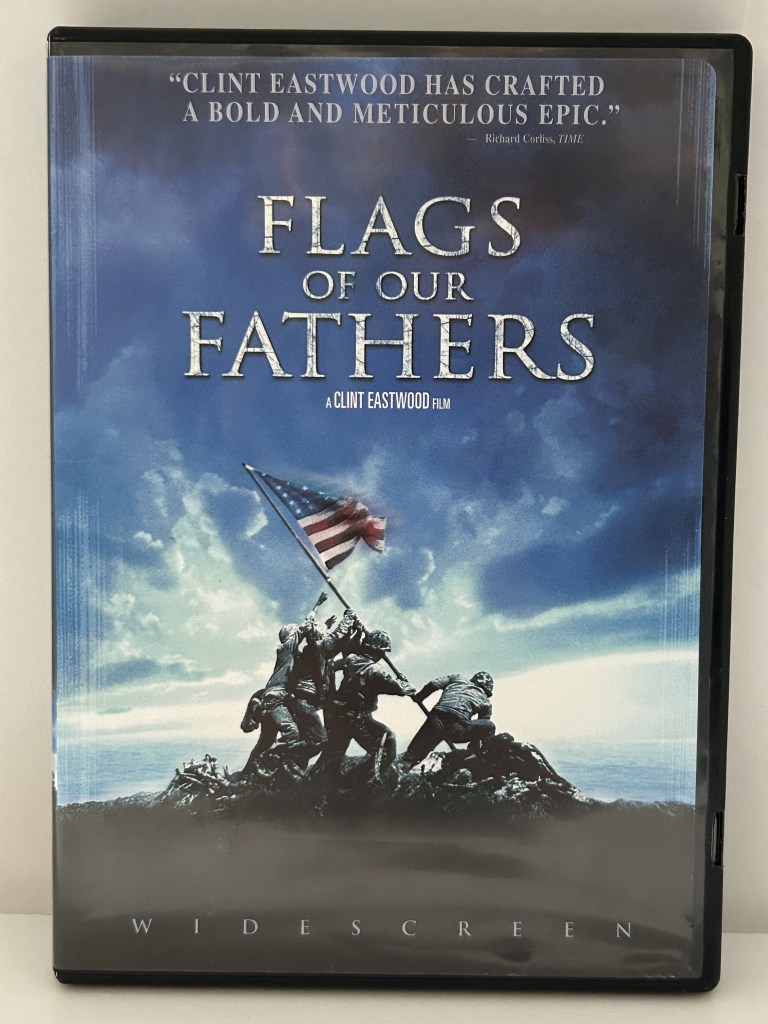
Flags of Our Fathers 2006, directed by Clint Eastwood
Rating: 7/10
In 2006, Clint Eastwood released two movies—both of which revolve around the battle of Iwo Jima. Flags of Our Fathers tells the story of the American soldiers, though it focuses less on the battle and more on the aftermath of their heroism as they return to the United States.
The ideas here really interesting, even though they are definitely not unique. This film is really about the divide between soldiers and citizens and how war stories are told and for whom they are told. The public is happy to have the photograph of the men raising the flag and to celebrate this uncomplicated view of heroism. Meanwhile, the soldiers who are on a publicity tour are troubled by this uncomplicated view and the fact that their experience has not been one of pure valor and bravery and that they know the photo itself is just a staged bit of publicity. This conflict between soldiers dealing with what they have been through and the citizenry celebrating them without fully understanding (or even wanting to understand) is well-worn ground that I have seen and read a million times by this point, but it is continually fascinating, and as presented here it is done well. Watching Eastwood both celebrate these men while also pointing out how false their iconic moment really is demonstrates how masterful a filmmaker he is.
However, I do wish that Eastwood had made the movie a bit more simple. All the scenes of the men in the United States at fancy parties and gatherings meant to celebrate them while they are tortured internally are great—but they are muddled by flashbacks that feel unneeded and make the movie more cliché. We’ve seen these kinds of battles before, we’ve seen these basic stories before—nothing from these flashbacks is anything new and they are all already assumed by the audience. They are especially unneeded when Eastwood’s actors make clear exactly what they are thinking in their performances. He should have trusted in his actors and kept us trapped in the moments of supposed peace with them to show how discomfiting this disharmony can be instead of taking his interesting ideas and mixing them up with unnecessary and unspectacular flashbacks. I do like the experimental risks Clint Eastwood took in Bird, but for the most part I think he is at his best when he embraces what a classical and straightforward director he is—he has such great strengths and he is definitely more suited to linear storytelling.
Flags of Our Fathers is a good movie—it is a good watch, with a good cast, good direction, and interesting ideas. It is not one of the best war movies, nor one of Eastwood’s best movies. Watching it on its own, it feels fine. However, when watched (and released) around the same time as Letters from Iwo Jima, it very much pales in comparison.
 The Movie Room
Leave a comment