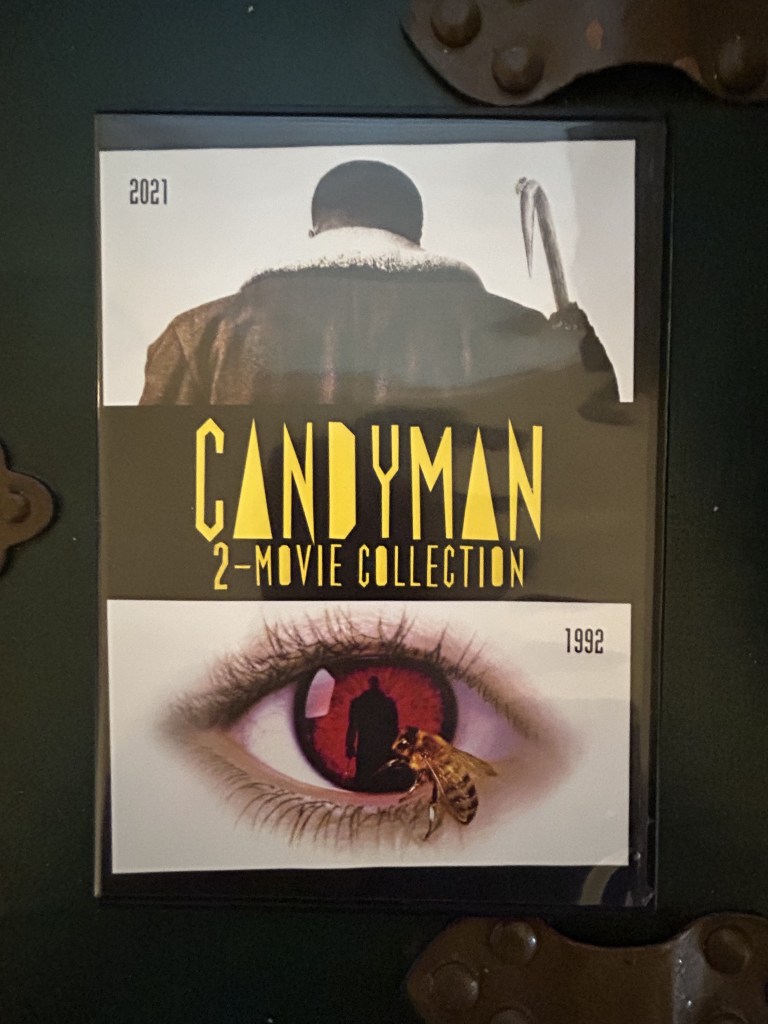
Candyman 2021, directed by Nia DaCosta
Rating: 6/10
In theory I like the idea of legacy sequels, and how they make classic horror films fresh for a new audience, allow for the opportunity to restart the franchise, and bring back iconic horror actors in parts that often helped make them famous in the first place. Unfortunately, I don’t think I’ve yet to actually see a legacy sequel that I’ve fully enjoyed or that I think has lived up to the potential inherent in this subgenre. Nia DaCosta’s Candyman may be better than most legacy sequels I’ve seen, but it is still a huge disappointment for me.
There are many issues with sequels, especially as they drown out the production of original films, but one benefit to sequels is that there is often less need for exposition because the first film generally does that. There is usually some, especially in horror films (Friday the 13th Part 2 introducing Jason as the murderer, for example), but for the most part the world has been built and now we get to just play in it. A great example of this is Dune and Dune: Part Two; I was kind of cool on the first one as it was so much information squeezed in, but the second one that just allows us to live in the action of that world was one of the best cinema-going experiences I’ve had this past year. However, Nia DaCosta and her Candyman co-writers Jordan Peele and Win Rosenfeld apparently decided that what this legacy sequel needed was MORE exposition. The mythology of the first one definitely raises some questions (if Danielle Robitaille was lynched by white men, then why is he mostly killing poor black residents?), but it is specific and those questions are made to make you think. This movie introduces the idea of a hive of Candymen, so all specificity is gone, and it doesn’t seem to want its audience to think because every time it introduces a new Candyman it has the characters say the thesis of each particular backstory in a way you can basically hear the bold, underline, and italics in the script.
The script here not only makes this movie a bad sequel, but also holds it back as a film in and of itself. In the first film, the kills by Candyman are organic to the plot, but here all the murders feel just put in because they are expected with only the barest of strings connecting them to the main plot. The first film’s script also did a great job of showing people from different walks of life, but that is not the case here. Most of the characters are in the elite art scene, so they talk in bon mots and seem to be monologuing at each other more than having realistic discussions. Besides the clichéd view of artists, it also features stereotypical gay characters who get mad at the idea of a dessert wine being served out of place and have other such Real Housewife-y affects. Worst of all, perhaps, for a film about the horror of gentrification, the only non-elite-class character really given much time is the one played by Colman Domingo, a fantastic actor, who here just spits out even more exposition and seems to have no life outside of his scenes, as if when the camera isn’t on him his character just ceases to exist.
I’ve now seen two out of three films Nia DaCosta has directed, having also seen The Marvels, and like that Marvel Cinematic Universe film, this movie has some really cool visuals but the script is just a mess—I’m excited to see what she is able to do with a film that she directs but doesn’t write. There are some cool ideas here (even if not well executed), but tying them in as a sequel instead of a remake just raises even more questions; a new version of Candyman where he is a hive-mind being that is more like a superhero is a cool idea, but tying it directly into the original where he is very much a villain (though one with a tragic backstory) is such a weird choice. I thought this was one I would like better on a rewatch, with proper expectations set, but the opposite has sadly been true.
 The Movie Room
Leave a comment