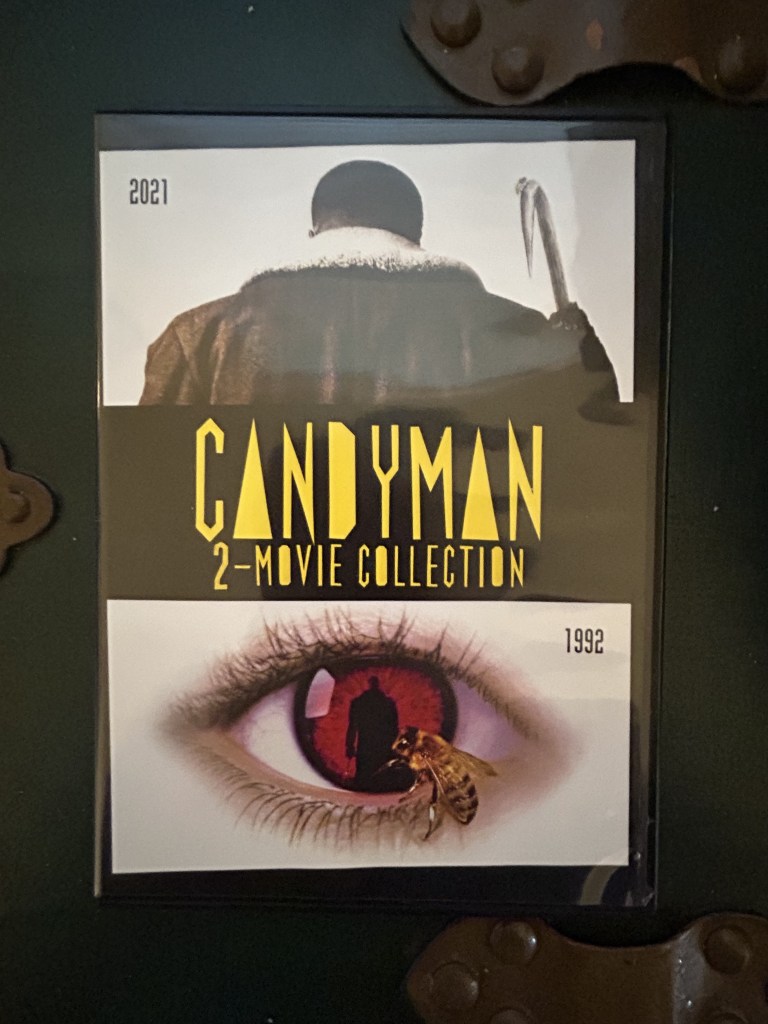
Candyman 1992, directed by Bernard Rose
Rating: 10/10
Candyman came out in 1992—that is between the fifth and sixth Halloween films, between the eighth and ninth Friday the 13th films, between the sixth and seventh A Nightmare on Elm Street films, between the third and fourth The Texas Chainsaw Massacre films, and between the third and fourth Child’s Play films; all this to say that by 1992 the slasher glory days had faded. And yet, based off of a Clive Barker story and featuring a fantastic score by Philip Glass, Candyman is one of the best of its kind (and started its own franchise with two pretty bad sequels coming out before the 2021 legacy sequel).
Candyman is one of those movies that follows a formula, but does it so well that becomes an example of why the formula exists instead of being saddled with that negative tag: “formulaic.” It starts off immediately with introducing the villain and his method of murder, as a couple decide to say “Candyman” into the mirror five times as foreplay and pay the price when Tony Todd shows up with a hook for a hand. This kind of intro murder is de rigueur in slasher films and the best ones rely on great villains (like those from the list of franchises I gave at the beginning); Todd as Candyman is one of the best. His murders are then investigated by grad student Helen Lyle who becomes caught up in his web, like Clarice Starling in The Silence of the Lambs or Rachel Keller in The Ring. Lyle is played fantastically by Virginia Madsen, and part of the reason this film succeeds so magnificently well is because of the relationship that forms between Todd and Madsen—these actors really sell it and make it beautiful.
Like a lot of horror, there is a deeper meaning to what is going on here, and this film strikes a great balance of being an entertaining horror film on the surface that can still be dug into. Our main characters are mostly white academics (with the exception of Kasi Lemmons as Lyle’s co-author of their Candyman study) looking into an urban legend dealing with the deaths of mostly poor black residents of Cabrini Green in Chicago. There’s a lot of cool ideas about how Candyman thrives on his story being told (like how being remembered powers Freddy Kreuger) and how this is being pushed by not only the academics but also the local gang at Cabrini Green who co-opt his likeness. I, for one, find it fascinating that the mostly white world of academia and the predominantly black gangs are accidentally working separately to the same result, which is the death of innocent black Chicagoans. Vanessa Williams as Anne-Marie McCoy does a great job of showing how she just wants to survive and raise her baby, and that both the gang that lives there and the invasive academics are threats to that goal as both are keeping Candyman alive through word of mouth; this movie is not blaming one side or the other, but saying that no matter what side you are on, the current systems in place in our society are all working together to further oppress the underprivileged.
Candyman is a super satisfying slasher film, a great exploration of social injustice, a fantastic acting showcase, and has one of the best horror scores on top of all that. There are some things that could be better (as with any film), but even with its flaws this is a movie that never fails to suck me into it on multiple levels.
 The Movie Room
Leave a comment