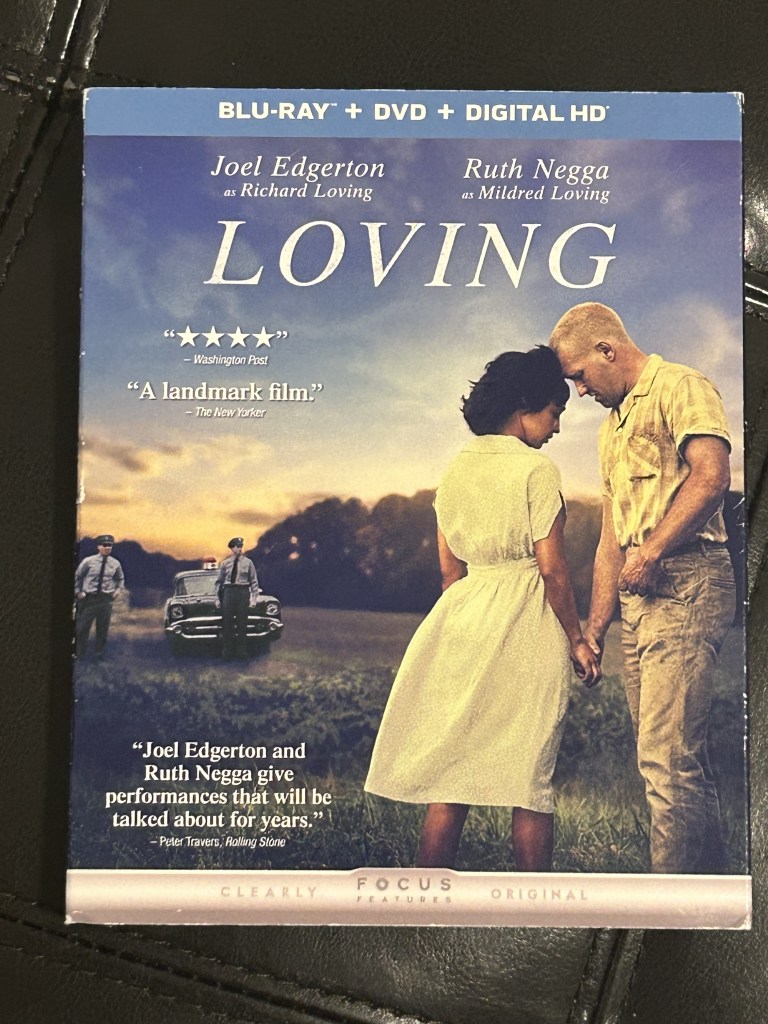
Loving 2016, directed by Jeff Nichols
Rating: 10/10
Jeff Nichols’s directorial style is definitely on the slow side, and so I can see why a lot of people don’t love his movies, but I really do. He is one of my favorite directors, and Loving, his movie about Richard and Mildred Loving and the 1967 Supreme Court case Loving v. Virginia, is my favorite of his films.
Part of the reason that I love this movie so deeply is that Joel Edgerton and Ruth Negga give two of my all-time favorite performances in any movie. It was my first time seeing Ruth Negga in anything, and her calm sweetness just blew me away—now whenever I see she is in a movie (like Ad Astra or Passing), I get excited. While she was a new discovery, Joel Edgerton here had me reevalutating my previous vision of him. I’d seen him in plenty of movies before (Smokin’ Aces, Warrior, The Great Gatsby) and he had never been bad in them but he never caught my attention as more than just a tough guy who is serviceable in his part—but as Richard Loving he is revolutionary. He didn’t get an Academy Award nomination here (though Ruth Negga did) which does not surprise me as the Academy tends to favor big performances and what Joel Edgerton does in this movie is all about being quiet. He fits into traditional masculine roles, but instead of showing the violent and toxic side like a lot of performances (including his part in The Great Gatsby) he highlights how masculinity can be positive and it is so refreshing. Watching Richard and Mildred together feels like one of the most naturalistic portrayals of a happily married couple ever—there is conflict (they are being arrested just because of who they married, and going up to the Supreme Court because of it), but there is no danger of their relationship ever falling apart and seeing such a happy and stable relationship feels amazing. The general wisdom goes that when any couple on a sitcom gets together then the show has to die because there is nothing left to do, but this shows that happy couples done well can still be great to watch.
Besides the lead performances, Nichols’s seemingly laid back directing style really suits this Americana narrative. This came out the same year as his sci-fi road movie Midnight Special, which is also great, but it feels like the burdens of such a plot-heavy script get in the film’s way at points, where here the story is just allowed to breathe. Yes, characters go to jail, they go to court, their child runs out in the street, etc., but none of it is played for melodrama—it is just a slice of life and it is played as such. Loving v. Virginia was such a landmark case, and this movie doesn’t downplay that importance, but it instead makes it feel more important by highlighting just how regular the Lovings and their situation is—they aren’t together because they wanted to protest racist laws, they just love each other; they didn’t go to the Supreme Court because they wanted to change our nation, they just wanted to be allowed to be married in the state they called home. There is a place for movies about loud and proud revolutionaries (Spike Lee’s masterpiece Malcolm X being perhaps my favorite), but the inherent normalcy of the Lovings makes their extraordinary actions feel that much more powerful.
Jeff Nichols is a master at depicting America in his films, with movies such as Mud and The Bikeriders, but Loving stands out as the best for me because its storyline is perhaps the most consequential despite featuring the most normal characters and that duality works extraordinarily well with the beautifully matter-of-fact filmmaking style. Also it takes one hell of a movie to make me completely reevaluate my opinions of an actor, but here I am proudly admitting I was wrong about Joel Edgerton.
 The Movie Room
Leave a comment